7 Common Calibration Errors That Wreck Temperature Sensor Accuracy
Kehren wir zu einem aktiven Produktionsbetrieb zurück. Jede Sekunde Stillstand kann für das Unternehmen einen Verlust von Tausenden bedeuten. Kalibrierung des Temperatursensors ist eine Wissenschaft, in der kleine Fehltritte große Probleme verursachen.
At Tempsens, we’ve worked alongside industry leaders in steel, pharma, food, and power, solving these calibration errors in the field. Calibrating is not simply a box-ticking exercise, it is your first defense against sensor drift, expensive mistakes, and compliance problems. This blog brings together real-world stories, industry best practices, and the most common calibration mistakes, and how to sidestep them with confidence.
1. Ignorieren der Sensordrift
Over time, a temperature sensor in a harsh industrial environment will naturally drift, whether it is a thermocouple, an FTE, or a thermistor. While some teams may only handle calibration if an issue arises, they may not be aware that sensor drift problems can occur unnoticed. You might pass your audits, but is your process truly in control?
Vermeiden Sie es:
- Planen Sie, die Temperatursensoren in regelmäßigen Abständen zu kalibrieren, basierend auf der Kritikalität des Prozesses und den Empfehlungen des Herstellers (Tempsens bietet sowohl Vor-Ort- als auch laborbasierte B2B-Kalibrierungsdienste für Temperatursensoren an).
- Verfolgen Sie die Drift-Trends, um kleinere Anpassungen zu erkennen, bevor sie zu bedeutenden Fehlern werden.
2. Verwendung des falschen Referenztemperatursensors
Eine Kalibrierung ist nur so gut wie ihre Referenz. Die Verwendung einer nicht zertifizierten oder veralteten Referenz kann die Qualität beeinträchtigen. Referenztemperatursensor leads to false confidence and invisible errors. Think of a dry-block calibrator or liquid bath calibrator paired with a reference probe out of spec: you’re comparing “truth” to something already compromised. As a rule, your reference should be approximately 4× more accurate than the unit under test — a principle known as calibration uncertainty or TUR (Test Uncertainty Ratio), and a core requirement under any temperature sensor calibration standard.
Vermeiden Sie es:
- Always use certified, traceable reference standard, calibrated to national/international norms.
- Um die Genauigkeit zu gewährleisten, sollten die Referenzsensoren regelmäßig ausgetauscht werden.
3. Unzureichende Stabilisierungszeit
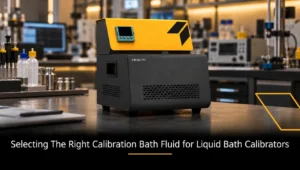
Ever seen someone eager to finish the calibration process, dunking sensors into the bath and reading results right away? Skipping stabilization is one of the top temperature calibration errors. The probe and reference need time to reach thermal equilibrium. If not, readings are off—especially in multi-sensor calibration setups. As a general rule of thumb: the dry block calibrator normally takes 3–5 minutes in a soak time per set temperature, whereas a liquid bath calibrator will require 5–10 minutes of time before the probe and reference reach equilibrium.
Vermeiden Sie es:
- Bevor Sie irgendwelche Werte aufzeichnen, warten Sie, bis sich die Temperatur stabilisiert hat.
- Nimm ein Bad., Flüssigkeitsbadkalibrator, Trockenblockkalibrator, oder Schwarzkörperkalibrator mit gleichmäßiger Temperaturverteilung (Tempsens bietet diese mit schneller Stabilisierung an).
4. Falsche Platzierung des Sensors im Kalibrierblock
Where you place the sensor during temperature sensor calibration makes all the difference. A dry-block calibrator typically has its insertion point in the middle. Inserting the probe too shallow or too deep, or using the wrong sleeve diameter, can introduce significant errors and cause you to fail your temperature calibration. The immersion depth should be at least 15× the probe’s outer diameter to avoid stem conduction errors.
Vermeiden Sie es:
- Beachten Sie die Anweisungen des Herstellers zur Sensorplatzierung.
- Verwenden Sie eng anliegende Ärmel, um eine optimale Wärmeübertragung zu gewährleisten.
- Führen Sie das System stets bis zur empfohlenen Tiefe ein (Tempsens stellt Benutzerhandbücher für alle Kalibrierungssysteme zur Verfügung).

5. Vernachlässigung der Kaltstellenkompensation (bei Thermoelementen)
Thermoelementkalibrierung can be derailed by cold junction errors. If the reference junction isn’t properly compensated, you get systematic offset—an invisible error that can ruin a batch or mislead process engineers. Also check to make sure that the thermocouple extension wires are of the compatible type. In many cases, incorrectly calibrated measurements can be traced to errors introduced by the use of mismatched thermocouple wires.
Vermeiden Sie es:
- Verwenden Sie Messgeräte mit integrierter Kaltstellenkompensation.
- Steckverbinder und Messgeräte sollten in Umgebungen mit stabilen Umgebungstemperaturen platziert werden.
- Validate your compensation method during every thermocouple calibration.
6. Vernachlässigung von Umweltfaktoren
Temperature calibration isn’t done in a vacuum. Drafts, sunlight, vibration, or fluctuating ambient temperatures can introduce errors—especially with high-accuracy sensors or during onsite temperature sensor calibration. Sometimes, even walking past a sensor during calibration can cause a jump! This is true for contact temperature sensor such as thermocouples and RTDs where the probe or its wiring is physically disturbed and the readings momentarily change.
Vermeiden Sie es:
- Kalibrieren Sie nach Möglichkeit in einer kontrollierten Umgebung.
- Sensoren und Referenzsonden vor Zugluft und Strahlungswärme schützen.
- Für die Feldkalibrierung, Tempsens Tragbare Systeme sind so konstruiert, dass die Umweltbelastung minimiert wird.
7. Unzureichende Dokumentation
After spending effort on the calibration process, missing or poor documentation leaves you exposed. Without clear calibration certificates, and traceable records, audits become a nightmare and root-cause analysis is nearly impossible. A calibration certificate should document the values including, but not restricted to, as-found and as-left values, reference standard number, calibration uncertainty, atmospheric conditions when calibration took place, name of technician and date according to ISO 17025. The most missed value in the calibration check is the as-found reading, which is a feature that is requested by auditors first of all because it is the only proof of drift that took place before calibration.
Vermeiden Sie es:
- Jedes Kalibrierungsergebnis, jeder Umgebungsfaktor und jeder verwendete Referenzstandard ist zu dokumentieren.
- Speichern Sie Datensätze in einem System, das sowohl für Prüfungen als auch zur Fehlerbehebung zugänglich ist.
Warum die Kalibrierung von Temperatursensoren wichtig ist
Reliable temperature measurement is the invisible backbone of every industrial process. Regular, professional calibration prevents sensor drift, reduces product recalls, supports compliance, and gives you the confidence to scale.
Whether you’re using a dry-block calibrator, liquid bath calibrator, or even a black body calibrator, following best practices is the key to Kalibrierung von Temperatursensoren erfolgreich.
Bewährte Verfahren für die industrielle Kalibrierung
- Use only traceable reference temperature sensors and certified equipment.
- Calibrate at stable and representative points across your process temperature range.
- Follow the instructions from your manufacturer for your temperature sensor, calibrator and application.
- If you have a critical or regulated application, consider professional b2b calibration services – Tempsens can calibrate in the lab or at your facility.
- Review calibration data regularly and investigate anomalies immediately.
Calibration requirements differ between contact temperature sensor and non-contact types — ensure your procedure matches the sensor technology in use.
Abschluss
Calibrating temperature sensors is not a one-time obligation with regard to every carrier system; it is a continuous practice to make your process data reliable, compliance to be preserved, and production to go uninterrupted. The seven errors in calibration described in this article are not unique examples. On the contrary, they are very common in steel mills, drug manufacturing, and food processing companies. Correctly identifying errors before they appear leads to way bigger savings of money than in case errors are not detected in time. Whether you do calibration in-house or whether you order calibration services, calibration standards one must follow define overall standards for the enterprise.
Für weitere Details besuchen Sie uns unter – Temperaturkalibrierung und -dienstleistungen
Anruf - +91-9358835576 Oder E-Mail – [email protected] [email protected]
FAQs
What are the most common calibration errors in temperature measurement?
Sensor drift, insufficient stabilization time, poor cold junction compensation, wrong reference standards, and poor documentation are the most common mistakes made during calibration that affect temperature sensors’ functioning.
Wie kann ich die Genauigkeit meines Temperatursensors verbessern?
Regular calibration in accordance with reference standards, keeping track of deviations and following placement instructions from the manufacturer are all required. Tempsens provides professional calibration services to guarantee maximum accuracy of temperature sensor.
What causes a temperature sensor to fail calibration?
Calibration failure normally take place due to sensor drift, improper calibration of a reference standard or the environmental disturbances or position of the probe during the calibration process.
How often should temperature sensors be calibrated?
The frequency of calibration depends on several factors: importance of process, operating environment and requirements of a manufacturer. Most of the high-risk and regulated activities require calibration within every 6 or 12 months.
Wie geht man bei der Kalibrierung eines Temperaturfühlers korrekt vor?
Properly place the probe in a stable dry block or liquid bath calibrator, let it thermally stabilize, and compare the readings with the certified reference standard.
Welcher Temperatursensor weist die höchste Genauigkeit auf?
The most accurate temperature sensors are platinum RTDs (Pt100 and Pt1000), especially if they are frequently calibrated and serviced to the standards complying with ISO 17025.
Bietet Tempsens eine Kalibrierung vor Ort an?
Yes. Tempsens has onsite and laboratory temperature sensor calibration services for industrial users in fields like food, steel, power, and pharmaceuticals.